
SEARCH WHAT YOU WANT
RoHS vs REACH: What's the Difference? 10 Substances vs All Chemicals
Time:2026-11-20
RoHS restricts 10 substances in electrical and electronic equipment and sets hard limits. REACH covers every chemical and requires disclosure when an SVHC exceeds 0.1%. For EU shipments, one report does not replace the other.
1. Two different logics, not two versions
Buyers often treat RoHS and REACH as an old and a new version of the same rule. They are not even built for the same purpose.
RoHS (EU 2011/65/EU, amended by 2015/863) lists exactly 10 substances: lead, mercury, cadmium, hexavalent chromium, PBB, PBDE, plus four phthalates (DEHP, BBP, DBP and DIBP). Cadmium is limited to 0.01%; everything else to 0.1%. Any substance on the list must stay below its limit. It works as a banned-items list.
REACH ((EC) No 1907/2006) covers all chemicals. There is no usable / not usable list. Instead it requires registration, evaluation, authorisation and restriction: substances above 1 tonne per year must be registered, substances of very high concern (SVHC) are placed on the candidate list, and an article containing an SVHC above 0.1% w/w must give the recipient enough information to use it safely. It is registration plus disclosure.
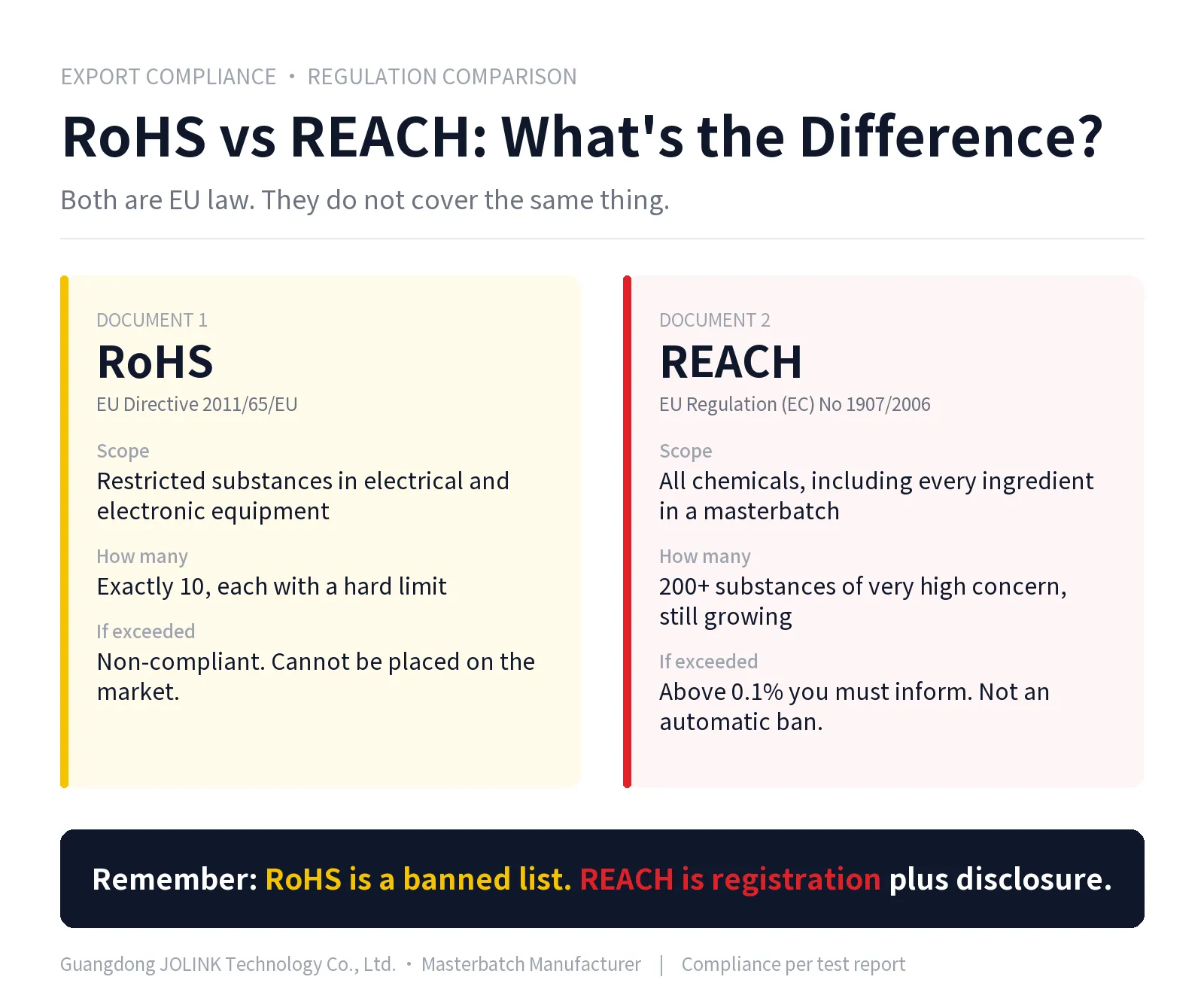
2. The difference in one table
|
Item |
RoHS |
REACH |
|
Scope |
Restricted substances in electrical and electronic equipment |
All chemicals, and their presence in articles |
|
How many |
Exactly 10 |
200+ SVHCs, and growing |
|
If exceeded |
Non-compliant, cannot be placed on the market |
Disclosure duty, not an automatic ban |
|
What a masterbatch needs |
Proof the 10 substances are below the limits |
A statement checked against the current SVHC list |
3. "RoHS and REACH compliant" is two questions
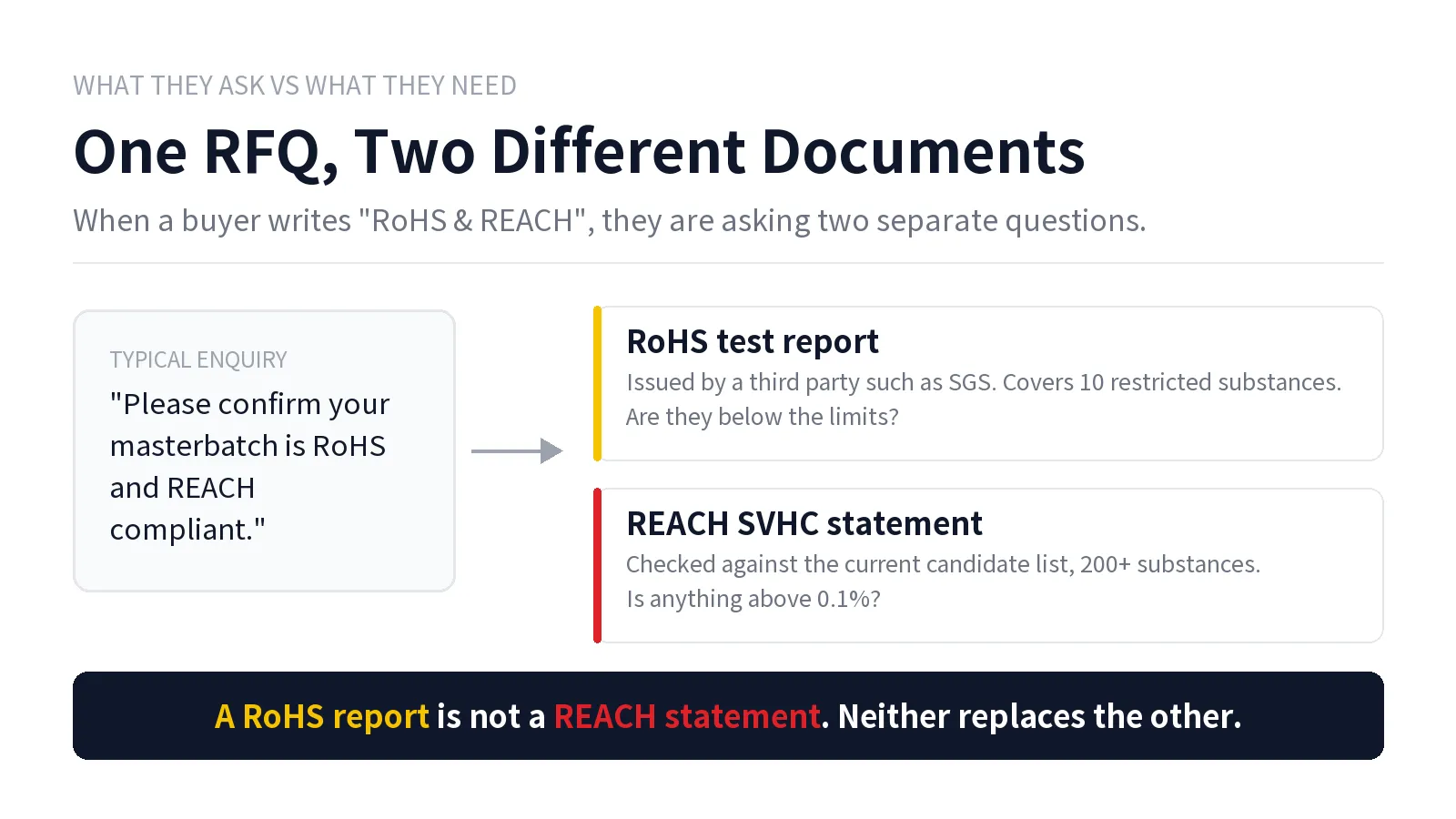
A RoHS test report measures the content of those 10 substances. An SVHC statement checks whether any of 200+ substances of very high concern exceeds 0.1%. The report does not cover SVHCs, and the statement does not judge limit values. Neither can stand in for the other.
4. Three mistakes we see most often
1. Treating REACH as a ban list. Above 0.1% you must inform; a substance is only restricted or banned once it is listed in Annex XVII or the authorisation list.
2. Assuming a RoHS report proves full environmental compliance. It does not cover most SVHCs, PAHs or heavy-metal migration.
3. Assuming a report lasts forever. The candidate list keeps growing, and any change of formulation or supplier means a fresh check. A report without a standard version and date is worth very little.
5. FAQ
Do I need both for masterbatch shipped to the EU?
Yes. RoHS depends on whether your customer's product falls under the directive; REACH applies to all articles, with no exemption.
Is an SVHC above 0.1% prohibited?
No. You must inform the recipient and provide safe-use information. Whether it is banned depends on whether it is also on the restriction or authorisation list.
Can a self-declaration replace a test report?
It can be issued, but most European buyers ask for third-party reports. What counts is the report itself.
RoHS restricts 10 substances in electrical and electronic equipment and sets hard limits. REACH covers every chemical and requires disclosure when an SVHC exceeds 0.1%. For EU shipments, one report does not replace the other.
1. Two different logics, not two versions
Buyers often treat RoHS and REACH as an old and a new version of the same rule. They are not even built for the same purpose.
RoHS (EU 2011/65/EU, amended by 2015/863) lists exactly 10 substances: lead, mercury, cadmium, hexavalent chromium, PBB, PBDE, plus four phthalates (DEHP, BBP, DBP and DIBP). Cadmium is limited to 0.01%; everything else to 0.1%. Any substance on the list must stay below its limit. It works as a banned-items list.
REACH ((EC) No 1907/2006) covers all chemicals. There is no usable / not usable list. Instead it requires registration, evaluation, authorisation and restriction: substances above 1 tonne per year must be registered, substances of very high concern (SVHC) are placed on the candidate list, and an article containing an SVHC above 0.1% w/w must give the recipient enough information to use it safely. It is registration plus disclosure.
2. The difference in one table
|
Item |
RoHS |
REACH |
|
Scope |
Restricted substances in electrical and electronic equipment |
All chemicals, and their presence in articles |
|
How many |
Exactly 10 |
200+ SVHCs, and growing |
|
If exceeded |
Non-compliant, cannot be placed on the market |
Disclosure duty, not an automatic ban |
|
What a masterbatch needs |
Proof the 10 substances are below the limits |
A statement checked against the current SVHC list |
3. "RoHS and REACH compliant" is two questions
A RoHS test report measures the content of those 10 substances. An SVHC statement checks whether any of 200+ substances of very high concern exceeds 0.1%. The report does not cover SVHCs, and the statement does not judge limit values. Neither can stand in for the other.
4. Three mistakes we see most often
1. Treating REACH as a ban list. Above 0.1% you must inform; a substance is only restricted or banned once it is listed in Annex XVII or the authorisation list.
2. Assuming a RoHS report proves full environmental compliance. It does not cover most SVHCs, PAHs or heavy-metal migration.
3. Assuming a report lasts forever. The candidate list keeps growing, and any change of formulation or supplier means a fresh check. A report without a standard version and date is worth very little.
5. FAQ
Do I need both for masterbatch shipped to the EU?
Yes. RoHS depends on whether your customer's product falls under the directive; REACH applies to all articles, with no exemption.
Is an SVHC above 0.1% prohibited?
No. You must inform the recipient and provide safe-use information. Whether it is banned depends on whether it is also on the restriction or authorisation list.
Can a self-declaration replace a test report?
It can be issued, but most European buyers ask for third-party reports. What counts is the report itself.
Previous: No more data

Contact Us
Tel: +86 757 8118 6668/+86 139 2320 6383
Sales Hotline: +86 139 2320 6383
Address: No. 55, Yong'an Avenue, Guanyao, Shishan Town, Nanhai District, Foshan City, Guangdong Province, China.
Inquire
Copyright © 2026 Guangdong Jolink Technology Co., Ltd.