
SEARCH WHAT YOU WANT
Why is the particle size of our black masterbatch so uniform?
Time:2026-10-06
Pick up a handful of our black masterbatch and spread it out. The pellets come out the same length and the same thickness, as if they had all been cut from one die.
That look is not luck. It comes from holding every stage of the line to one standard,
from extrusion and melting through to conveying and screening: which pelletizing method you choose, how you hold melt temperature and pressure, how you cool the pellets, and how you screen them.
What "uniform" actually means
A single pellet has two dimensions worth controlling: diameter and length.
Diameter starts at the die. The orifice in the die head sets the base diameter, and the machining tolerance on that orifice decides how tight the spread is.
Length is set further down the line, by the pelletizing method.
Real uniformity comes down to three things: the same diameter, the same length, and no linked pellets, fines or misshapen pieces.
The industry term for getting all three right is a narrow particle size distribution.
Which pelletizing method suits you depends on the base resin and on where the masterbatch is going. There are four mainstream routes.
Each has its own control points, but none of them deliver a narrow particle size distribution unless the melt itself stays stable.
2. The prerequisite: a stable melt, with melt pressure and temperature under control
Holding the die orifice to ±0.02 mm is only the starting point. When melt pressure swings, the extrudate swings with it, running thick one minute and thin the next.
Even a high-precision pelletizer cannot rescue that. The pellets still come out at different sizes.
(1) Melt pressure control
Build a stable back pressure in the homogenizing zone and at the die head, and keep melt pressure variation within ±0.3 MPa during the run.
If it goes outside that band, check for a blocked screen pack, unstable feeding or poor carbon black dispersion, and do not carry on running while the pressure is unstable.
Set the target melt pressure from the viscosity of the material. Low-viscosity PE masterbatch runs at 1.6–2.2 MPa. Highly filled, high-viscosity grades run at 2.2–3.4 MPa.
(2) Melt temperature control
Set barrel zone and die temperatures to the values specified for the base resin, and keep deviation within ±3 °C.
With heat-sensitive, high-carbon-black materials such as EVA and TPE, never let the melt overheat.
Overheating degrades the melt and makes it foam and stick to the cutter blades. You also need the temperature even across every die opening.
Uneven flow from one opening to another is what produces misshapen pellets.
Only start the pelletizer once melt temperature and melt pressure are holding steady inside the process window.
3. Choosing a pelletizing method
The four mainstream methods suit different materials and different end uses.
|
Pelletizing method |
Suitable materials |
Typical end use |
Key points |
|
Strand pelletizing |
General-purpose polyolefin black masterbatch with good flow: PE, PP, EVA |
Pipe and tubing, standard injection molding, masterbatch for compounding and modification |
Clean, even cut faces; low equipment cost; suits low to medium viscosity materials |
|
Air-ring pelletizing |
Moisture-sensitive masterbatch that cannot take water cooling; EVA and POE elastomer black masterbatch |
Thin films, thin-wall injection molding, elastic parts |
No water cooling, so no water pickup; low sticking; small footprint |
|
Water-ring pelletizing |
Medium to high viscosity PE and PP; medium-filled black masterbatch |
Injection molding, blow molding, masterbatch for cable compounds |
Die-face hot cutting gives rounded pellets; high output; good sphericity |
|
Underwater pelletizing |
High carbon black loading, high viscosity and heat-sensitive masterbatch; TPU and TPE elastomer black masterbatch |
High-end films, cable sheathing, precision injection molding |
Cutting and cooling in a closed water circuit, so the particle size distribution stays narrow and there are few linked pellets |
(1) Strand pelletizing
Suitability. General-purpose polyolefin black masterbatch with good flow, compatible with PE, PP and EVA.
Mainly used for pipe and tubing, standard injection molding, and masterbatch for compounding and modification.
Pellet length follows a simple formula: pellet length = haul-off line speed ÷ (cutter speed × number of blades).
The haul-off unit and the pelletizer have to run in sync through variable-frequency drives, with the speed ratio locked. Inspect and change blades on a fixed schedule,
so that blunt blades never leave tails or linked pellets behind. Keep the tension even across all the strands.
(2) Air-ring pelletizing
Suitability. Moisture-sensitive masterbatch that cannot take water cooling, plus EVA and POE elastomer black masterbatch.
Mainly used for films, thin-wall injection molding and elastic parts.
No water is involved here; cool air does the work.
This is a die-face cutting process, so pellet size is set by the die orifice diameter, the extrusion throughput and the cutter speed together.
When throughput changes, cutter speed has to change with it. Control the air volume and air temperature to stop pellets clumping and sticking.
(3) Water-ring pelletizing
Suitability. Medium to high viscosity PE and PP, and medium-filled black masterbatch. Mainly used for injection molding, blow molding and masterbatch for cable compounds.
The melt is cut the moment it leaves the die, which gives rounded pellets and high output. Control the gap between the cutter disc and the die face closely.
Filter the circulating water so that fines do not keep circulating and clinging to pellet surfaces, and follow through with proper dewatering and drying.
(4) Underwater pelletizing
Suitability. High carbon black loading, high viscosity and heat-sensitive masterbatch, plus TPU and TPE elastomer black masterbatch.
Mainly used for high-end films, cable sheathing and precision injection molding.
Cutting and cooling both happen inside a closed water chamber, which keeps the particle size distribution narrow and the number of linked pellets low.
The trade-off is tight tolerances on the die seal, chamber water pressure and water temperature. Get those out of balance and you get defects such as bubble pellets and porous pellets.
On any die-face cutting line, whether air-ring, water-ring or underwater, do not run with large swings in extrusion throughput.
Check blade edges on a regular schedule and replace them at the end of their service life, instead of waiting for off-spec pellets to show up first.
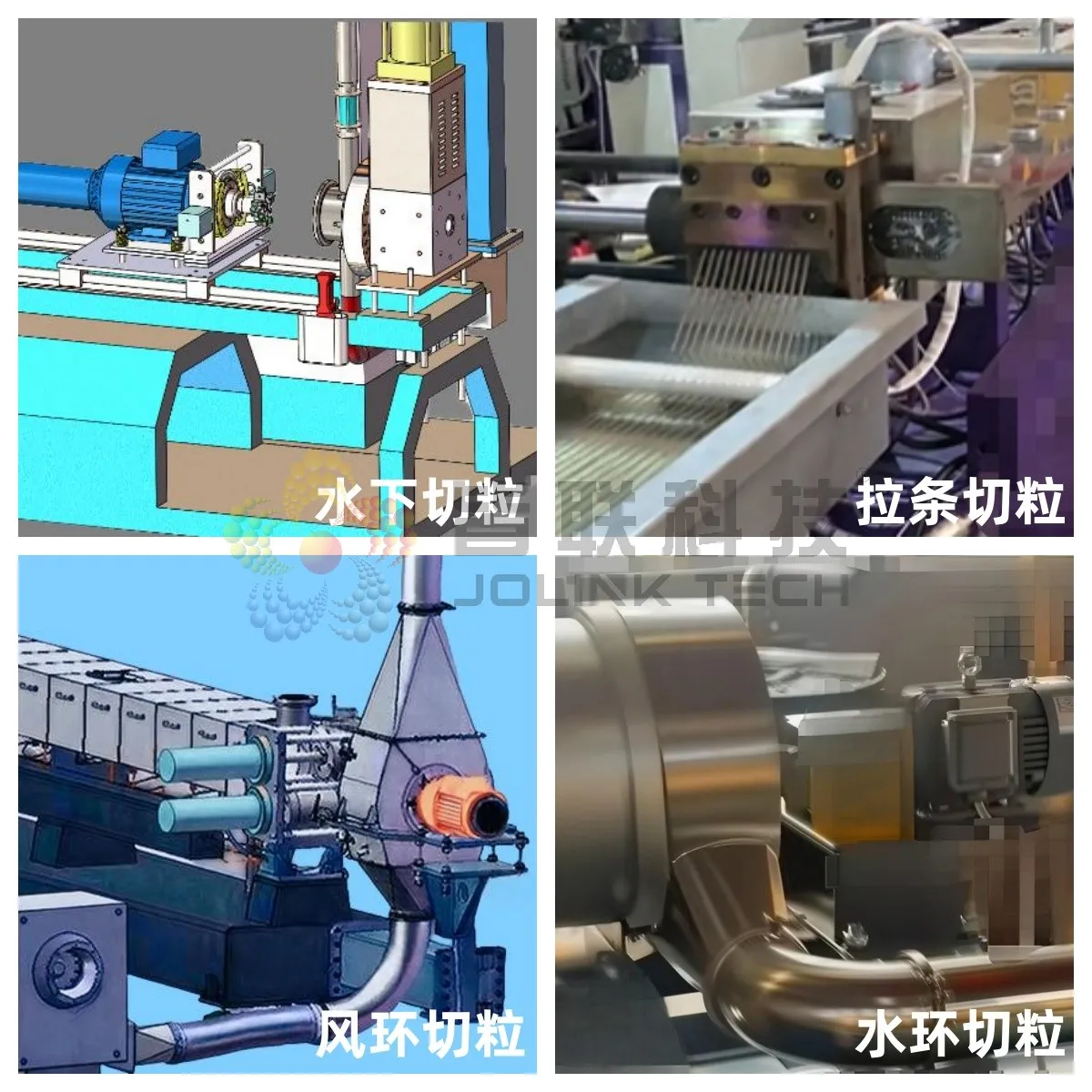
4. Cooling water temperature: when you cut matters more than how fast
Cutting melt is really about the state of the material at the moment of the cut.
Temperature and hardness decide cut quality. In strand pelletizing, if the strand has already cooled hard by the time it reaches the cutter,
the blade edge chips and you get a pile of fines and misshapen pellets.
Die-face hot cutting works differently. The melt is cut the instant it leaves the die orifice, while viscosity and temperature are still even, and the cut comes out clean.
Cooling targets by process:
Strand pelletizing water bath. General-purpose PE and PP masterbatch: 40–60 °C. Elastomer-based masterbatch: 60–75 °C. Hold the water within ±2 °C.
Too cold and the strand quenches, turns brittle and throws off more chips. Too warm and it is under-cooled, and pellets stick together.
Water-ring pelletizing. Hold the circulating water at 45–65 °C. That is enough to cool and set the pellets without the thermal shock that generates fines.
Underwater pelletizing. Keep the chamber water at 50–70 °C and match the chamber water pressure to it. Too cold and you get bubble pellets. Too warm and cooling is insufficient, and pellets stick.
Air-ring pelletizing. Cool with air, control the discharge temperature and keep pellets from clumping.
5. Conveying the finished pellets
After pelletizing and dewatering, rough handling in conveying can still break pellets and create fresh fines.
Depending on how hard the masterbatch is, how easily it breaks and how much dust it throws, choose between vacuum conveying, positive-pressure conveying and bucket elevators.
1. Vacuum conveying. Good for hard, low-dust PE and PP black pellets.
Do not pull too high a vacuum, or pellets hit the pipe walls hard enough to break. Clean the pipework on a regular schedule so material does not sit and degrade into black specks.
2. Positive-pressure conveying. Good for medium-hardness masterbatch over long distances and at high throughput.
Keep the air velocity low and cut the number of 90° elbows, and the pellets take less impact wear. Pair it with a dust collection system to recover fines.
3. Bucket elevators. The right choice for highly filled grades, elastomers and fragile high-end masterbatch for film and cable.
They run slowly, so drop height stays low, and the buckets have no sharp edges to scrape or break pellets.
With elastic materials that also break easily, do not use high-velocity positive-pressure conveying. The fines will climb sharply and put extra load on the screening equipment downstream.
6. Screening , the last gate
Even with the line well under control, a small number of pellets come out too long or too short, along with fines. Screening is the step that takes them out.
Set up a two-deck screen to match the target specification. The top deck catches over-length pellets, the bottom deck removes fines.
Tune the frequency and inclination of the vibrating screen so that screening is thorough. Check the screens regularly and replace damaged ones immediately.
After each batch is dried, screen it to remove powder. Then sample each batch, sieve and weigh the sample, and record what share of pellets falls inside the target size range.
Whether the pellets are uniform is a question for the test data, not for the eye.
7. What uniform pellets actually change downstream
Uniform pellet size means the material feeds smoothly and does not bridge. It gives the equipment better metering accuracy, cuts color variation in the finished part, and leaves a clean surface with no pitting.
This matters most on automated dosing and continuous lines. Once pellet size starts drifting, the feed rate drifts with it, and the stability of everything downstream goes with it.
Pellet size is the uniformity you can see. There is another kind you cannot: how well the carbon black disperses inside the resin. We will look at that in the next post, with real test data.
Pick up a handful of our black masterbatch and spread it out. The pellets come out the same length and the same thickness, as if they had all been cut from one die.
That look is not luck. It comes from holding every stage of the line to one standard,
from extrusion and melting through to conveying and screening: which pelletizing method you choose, how you hold melt temperature and pressure, how you cool the pellets, and how you screen them.
What "uniform" actually means
A single pellet has two dimensions worth controlling: diameter and length.
Diameter starts at the die. The orifice in the die head sets the base diameter, and the machining tolerance on that orifice decides how tight the spread is.
Length is set further down the line, by the pelletizing method.
Real uniformity comes down to three things: the same diameter, the same length, and no linked pellets, fines or misshapen pieces.
The industry term for getting all three right is a narrow particle size distribution.
Which pelletizing method suits you depends on the base resin and on where the masterbatch is going. There are four mainstream routes.
Each has its own control points, but none of them deliver a narrow particle size distribution unless the melt itself stays stable.
2. The prerequisite: a stable melt, with melt pressure and temperature under control
Holding the die orifice to ±0.02 mm is only the starting point. When melt pressure swings, the extrudate swings with it, running thick one minute and thin the next.
Even a high-precision pelletizer cannot rescue that. The pellets still come out at different sizes.
(1) Melt pressure control
Build a stable back pressure in the homogenizing zone and at the die head, and keep melt pressure variation within ±0.3 MPa during the run.
If it goes outside that band, check for a blocked screen pack, unstable feeding or poor carbon black dispersion, and do not carry on running while the pressure is unstable.
Set the target melt pressure from the viscosity of the material. Low-viscosity PE masterbatch runs at 1.6–2.2 MPa. Highly filled, high-viscosity grades run at 2.2–3.4 MPa.
(2) Melt temperature control
Set barrel zone and die temperatures to the values specified for the base resin, and keep deviation within ±3 °C.
With heat-sensitive, high-carbon-black materials such as EVA and TPE, never let the melt overheat.
Overheating degrades the melt and makes it foam and stick to the cutter blades. You also need the temperature even across every die opening.
Uneven flow from one opening to another is what produces misshapen pellets.
Only start the pelletizer once melt temperature and melt pressure are holding steady inside the process window.
3. Choosing a pelletizing method
The four mainstream methods suit different materials and different end uses.
|
Pelletizing method |
Suitable materials |
Typical end use |
Key points |
|
Strand pelletizing |
General-purpose polyolefin black masterbatch with good flow: PE, PP, EVA |
Pipe and tubing, standard injection molding, masterbatch for compounding and modification |
Clean, even cut faces; low equipment cost; suits low to medium viscosity materials |
|
Air-ring pelletizing |
Moisture-sensitive masterbatch that cannot take water cooling; EVA and POE elastomer black masterbatch |
Thin films, thin-wall injection molding, elastic parts |
No water cooling, so no water pickup; low sticking; small footprint |
|
Water-ring pelletizing |
Medium to high viscosity PE and PP; medium-filled black masterbatch |
Injection molding, blow molding, masterbatch for cable compounds |
Die-face hot cutting gives rounded pellets; high output; good sphericity |
|
Underwater pelletizing |
High carbon black loading, high viscosity and heat-sensitive masterbatch; TPU and TPE elastomer black masterbatch |
High-end films, cable sheathing, precision injection molding |
Cutting and cooling in a closed water circuit, so the particle size distribution stays narrow and there are few linked pellets |
(1) Strand pelletizing
Suitability. General-purpose polyolefin black masterbatch with good flow, compatible with PE, PP and EVA.
Mainly used for pipe and tubing, standard injection molding, and masterbatch for compounding and modification.
Pellet length follows a simple formula: pellet length = haul-off line speed ÷ (cutter speed × number of blades).
The haul-off unit and the pelletizer have to run in sync through variable-frequency drives, with the speed ratio locked. Inspect and change blades on a fixed schedule,
so that blunt blades never leave tails or linked pellets behind. Keep the tension even across all the strands.
(2) Air-ring pelletizing
Suitability. Moisture-sensitive masterbatch that cannot take water cooling, plus EVA and POE elastomer black masterbatch.
Mainly used for films, thin-wall injection molding and elastic parts.
No water is involved here; cool air does the work.
This is a die-face cutting process, so pellet size is set by the die orifice diameter, the extrusion throughput and the cutter speed together.
When throughput changes, cutter speed has to change with it. Control the air volume and air temperature to stop pellets clumping and sticking.
(3) Water-ring pelletizing
Suitability. Medium to high viscosity PE and PP, and medium-filled black masterbatch. Mainly used for injection molding, blow molding and masterbatch for cable compounds.
The melt is cut the moment it leaves the die, which gives rounded pellets and high output. Control the gap between the cutter disc and the die face closely.
Filter the circulating water so that fines do not keep circulating and clinging to pellet surfaces, and follow through with proper dewatering and drying.
(4) Underwater pelletizing
Suitability. High carbon black loading, high viscosity and heat-sensitive masterbatch, plus TPU and TPE elastomer black masterbatch.
Mainly used for high-end films, cable sheathing and precision injection molding.
Cutting and cooling both happen inside a closed water chamber, which keeps the particle size distribution narrow and the number of linked pellets low.
The trade-off is tight tolerances on the die seal, chamber water pressure and water temperature. Get those out of balance and you get defects such as bubble pellets and porous pellets.
On any die-face cutting line, whether air-ring, water-ring or underwater, do not run with large swings in extrusion throughput.
Check blade edges on a regular schedule and replace them at the end of their service life, instead of waiting for off-spec pellets to show up first.
4. Cooling water temperature: when you cut matters more than how fast
Cutting melt is really about the state of the material at the moment of the cut.
Temperature and hardness decide cut quality. In strand pelletizing, if the strand has already cooled hard by the time it reaches the cutter,
the blade edge chips and you get a pile of fines and misshapen pellets.
Die-face hot cutting works differently. The melt is cut the instant it leaves the die orifice, while viscosity and temperature are still even, and the cut comes out clean.
Cooling targets by process:
Strand pelletizing water bath. General-purpose PE and PP masterbatch: 40–60 °C. Elastomer-based masterbatch: 60–75 °C. Hold the water within ±2 °C.
Too cold and the strand quenches, turns brittle and throws off more chips. Too warm and it is under-cooled, and pellets stick together.
Water-ring pelletizing. Hold the circulating water at 45–65 °C. That is enough to cool and set the pellets without the thermal shock that generates fines.
Underwater pelletizing. Keep the chamber water at 50–70 °C and match the chamber water pressure to it. Too cold and you get bubble pellets. Too warm and cooling is insufficient, and pellets stick.
Air-ring pelletizing. Cool with air, control the discharge temperature and keep pellets from clumping.
5. Conveying the finished pellets
After pelletizing and dewatering, rough handling in conveying can still break pellets and create fresh fines.
Depending on how hard the masterbatch is, how easily it breaks and how much dust it throws, choose between vacuum conveying, positive-pressure conveying and bucket elevators.
1. Vacuum conveying. Good for hard, low-dust PE and PP black pellets.
Do not pull too high a vacuum, or pellets hit the pipe walls hard enough to break. Clean the pipework on a regular schedule so material does not sit and degrade into black specks.
2. Positive-pressure conveying. Good for medium-hardness masterbatch over long distances and at high throughput.
Keep the air velocity low and cut the number of 90° elbows, and the pellets take less impact wear. Pair it with a dust collection system to recover fines.
3. Bucket elevators. The right choice for highly filled grades, elastomers and fragile high-end masterbatch for film and cable.
They run slowly, so drop height stays low, and the buckets have no sharp edges to scrape or break pellets.
With elastic materials that also break easily, do not use high-velocity positive-pressure conveying. The fines will climb sharply and put extra load on the screening equipment downstream.
6. Screening , the last gate
Even with the line well under control, a small number of pellets come out too long or too short, along with fines. Screening is the step that takes them out.
Set up a two-deck screen to match the target specification. The top deck catches over-length pellets, the bottom deck removes fines.
Tune the frequency and inclination of the vibrating screen so that screening is thorough. Check the screens regularly and replace damaged ones immediately.
After each batch is dried, screen it to remove powder. Then sample each batch, sieve and weigh the sample, and record what share of pellets falls inside the target size range.
Whether the pellets are uniform is a question for the test data, not for the eye.
7. What uniform pellets actually change downstream
Uniform pellet size means the material feeds smoothly and does not bridge. It gives the equipment better metering accuracy, cuts color variation in the finished part, and leaves a clean surface with no pitting.
This matters most on automated dosing and continuous lines. Once pellet size starts drifting, the feed rate drifts with it, and the stability of everything downstream goes with it.
Pellet size is the uniformity you can see. There is another kind you cannot: how well the carbon black disperses inside the resin. We will look at that in the next post, with real test data.
Previous: No more data

Contact Us
Tel: +86 757 8118 6668/+86 139 2320 6383
Sales Hotline: +86 139 2320 6383
Address: No. 55, Yong'an Avenue, Guanyao, Shishan Town, Nanhai District, Foshan City, Guangdong Province, China.
Inquire
Copyright © 2026 Guangdong Jolink Technology Co., Ltd.