
SEARCH WHAT YOU WANT
What Actually Happens Inside a Twin-Screw Extruder
Time:2026-09-30
This month, our new twin-screw extruder arrived at the plant.
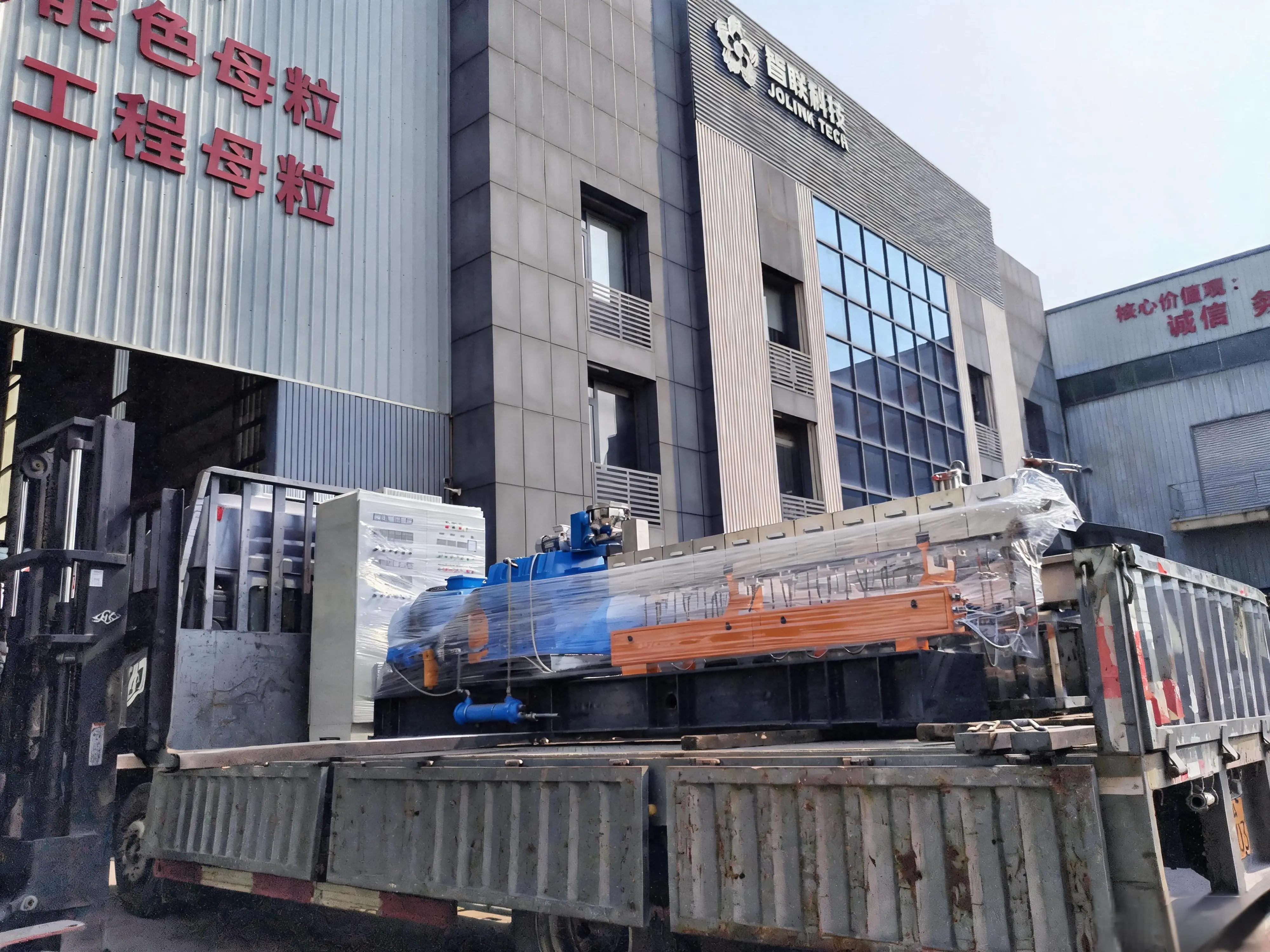
Installation, wiring, commissioning — the workshop has been a busy place.
A colleague asked: what does a new extruder actually change?
To answer that, it helps to go back to a single black masterbatch pellet.
From the hopper to the die head, what does it actually go through inside a twin-screw extruder?
Pre-mixing
The powder is charged into a high-speed mixer and blended for 1–2 minutes.
The additives are then added for a coating step that wets the pigment, and finally the base resin and dispersing agent are added and mixed for a few more minutes.
If everything is charged at once, the pigment is never properly wetted and coated, which undermines dispersion.
The powder also builds up heavily on the mixer's chamber wall and blades — a mistake worth avoiding in masterbatch production.
So what happens at each stage, and where? Here is the journey, zone by zone.
Feed zone: compacting the powder
Carbon black, carrier resin, and additives enter the barrel as loose powder.
The screw conveys them forward and compacts them.
Barrel temperature is deliberately kept low in this zone, so the material does not melt prematurely and the feed does not bridge.
Melting zone: carbon black gets its first coating
Barrel heating combined with screw shear melts the carrier resin, which wets and encapsulates the carbon black particles.
Carbon black has to be encapsulated by the melt first — only then does downstream dispersion mean anything.
Dispersive mixing zone: where the material is worked hardest
The kneading blocks are arranged at 30°, 45°, 60°, and 90° stagger angles.
Each time the material passes one, it is split, stretched, and recombined.
This is where carbon black agglomerates are broken open — from tens of microns down to the sub-micron range.
Why do some black masterbatches look bright and uniform, while others are full of black specks? The dividing line is drawn in this zone.
Distributive mixing zone: making the concentration uniform
Once the agglomerates are broken open, the pigment still has to spread evenly through the melt.
Shear here is comparatively mild.
The goal is uniform distribution, not harder shearing.
Vacuum venting zone: removing air and moisture
Air trapped in the powder and surface moisture are drawn off here.
Incomplete venting leaves voids in the pellets, and downstream products end up with bubbles and surface specks.
Pressure-building and homogenization zone: stabilizing first
Reverse-pitch screw elements build pressure and let the melt temperature and viscosity settle.
Any fluctuation in pressure shows up immediately as uneven strand diameter — and pellet size becomes unstable along with it.
Die head: forming strands, cutting pellets
The melt is extruded into strands (or pelletized directly in a water ring), then water-cooled and cut into pellets.
So how many times is the material actually worked?
Counting alone, something on the order of a thousand times.
But the more important answer is not the count. It is whether every single pass is the same.
A few degrees of temperature drift, or a screw configuration that does not match the formulation, and the same thousand passes can produce noticeably poorer dispersion.
Batch-to-batch color variation, black specks, and melt flow index (MFI) fluctuation usually trace back to exactly this.
That is why we invested in new equipment. So what does the new twin-screw extruder bring?
* Screw configurations can be fine-tuned formulation by formulation, so every pellet experiences as consistent a shear history as possible.
* Tighter barrel temperature control reduces batch variation caused by temperature drift.
* Higher torque and throughput keep output stable even under tight delivery schedules.
Equipment renewal is not renewal for its own sake.
Customers' products are getting thinner and more refined, and their requirements for dispersion quality and batch-to-batch consistency keep rising. Equipment and process technology have to keep up.
The next question: now that the new line is running, how much has dispersion actually improved, and how much more uniform are the pellets? In the next article, we let the test data speak.
About Jolink Tech — Jolink Tech specializes in the research, development, and production of black masterbatch, providing consistent black solutions for pipe, film, injection molding, and cable applications. Leave a comment or send us a message to request samples and technical data.
This month, our new twin-screw extruder arrived at the plant.
Installation, wiring, commissioning — the workshop has been a busy place.
A colleague asked: what does a new extruder actually change?
To answer that, it helps to go back to a single black masterbatch pellet.
From the hopper to the die head, what does it actually go through inside a twin-screw extruder?
Pre-mixing
The powder is charged into a high-speed mixer and blended for 1–2 minutes.
The additives are then added for a coating step that wets the pigment, and finally the base resin and dispersing agent are added and mixed for a few more minutes.
If everything is charged at once, the pigment is never properly wetted and coated, which undermines dispersion.
The powder also builds up heavily on the mixer's chamber wall and blades — a mistake worth avoiding in masterbatch production.
So what happens at each stage, and where? Here is the journey, zone by zone.
Feed zone: compacting the powder
Carbon black, carrier resin, and additives enter the barrel as loose powder.
The screw conveys them forward and compacts them.
Barrel temperature is deliberately kept low in this zone, so the material does not melt prematurely and the feed does not bridge.
Melting zone: carbon black gets its first coating
Barrel heating combined with screw shear melts the carrier resin, which wets and encapsulates the carbon black particles.
Carbon black has to be encapsulated by the melt first — only then does downstream dispersion mean anything.
Dispersive mixing zone: where the material is worked hardest
The kneading blocks are arranged at 30°, 45°, 60°, and 90° stagger angles.
Each time the material passes one, it is split, stretched, and recombined.
This is where carbon black agglomerates are broken open — from tens of microns down to the sub-micron range.
Why do some black masterbatches look bright and uniform, while others are full of black specks? The dividing line is drawn in this zone.
Distributive mixing zone: making the concentration uniform
Once the agglomerates are broken open, the pigment still has to spread evenly through the melt.
Shear here is comparatively mild.
The goal is uniform distribution, not harder shearing.
Vacuum venting zone: removing air and moisture
Air trapped in the powder and surface moisture are drawn off here.
Incomplete venting leaves voids in the pellets, and downstream products end up with bubbles and surface specks.
Pressure-building and homogenization zone: stabilizing first
Reverse-pitch screw elements build pressure and let the melt temperature and viscosity settle.
Any fluctuation in pressure shows up immediately as uneven strand diameter — and pellet size becomes unstable along with it.
Die head: forming strands, cutting pellets
The melt is extruded into strands (or pelletized directly in a water ring), then water-cooled and cut into pellets.
So how many times is the material actually worked?
Counting alone, something on the order of a thousand times.
But the more important answer is not the count. It is whether every single pass is the same.
A few degrees of temperature drift, or a screw configuration that does not match the formulation, and the same thousand passes can produce noticeably poorer dispersion.
Batch-to-batch color variation, black specks, and melt flow index (MFI) fluctuation usually trace back to exactly this.
That is why we invested in new equipment. So what does the new twin-screw extruder bring?
* Screw configurations can be fine-tuned formulation by formulation, so every pellet experiences as consistent a shear history as possible.
* Tighter barrel temperature control reduces batch variation caused by temperature drift.
* Higher torque and throughput keep output stable even under tight delivery schedules.
Equipment renewal is not renewal for its own sake.
Customers' products are getting thinner and more refined, and their requirements for dispersion quality and batch-to-batch consistency keep rising. Equipment and process technology have to keep up.
The next question: now that the new line is running, how much has dispersion actually improved, and how much more uniform are the pellets? In the next article, we let the test data speak.
About Jolink Tech — Jolink Tech specializes in the research, development, and production of black masterbatch, providing consistent black solutions for pipe, film, injection molding, and cable applications. Leave a comment or send us a message to request samples and technical data.
Previous: No more data

Contact Us
Tel: +86 757 8118 6668/+86 139 2320 6383
Sales Hotline: +86 139 2320 6383
Address: No. 55, Yong'an Avenue, Guanyao, Shishan Town, Nanhai District, Foshan City, Guangdong Province, China.
Inquire
Copyright © 2026 Guangdong Jolink Technology Co., Ltd.