
SEARCH WHAT YOU WANT
How does masterbatch produced ?
Time:2026-09-22
Have you ever thought about it?
The black granules that come out of your injection molding machines, blown film machines and pipe extrusion barrel, before being poured into your hopper, have gone through how many production processes?
Today, let's take a look at:
Step 1: Raw material weighting
Weigh according to the formula, just like the doctor in traditional Chinese medicine clinic mixing a specific type of medicinal herb.
Carbon black: 20% - 50% (depending on formula);
Carrier resin (PE, PP, ABS, EVA, etc.);
Dispersants, additives, etc. (according to formula).
The color and performance of the raw materials have already been qualitatively here.
Step 2: High-speed Mixing
The raw materials enter the high-speed mixer for pre-mixing, allowing the carbon black to evenly adhere to the surface of the resin, preparing for the next process; this step needs carried out evenly, eliminating the risk to make corrections later.
Step 3: Melt Extrusion
The mixture materials enter the twin-screw extruder, where it melts at the certain temperature. The shear force of the screws disperses the carbon black aggregates into the resin (this is the core process). Using the same batch of raw materials, why are some black masterbatch bright and uniform, while others are full of black spots? The answer is: Poor dispersion.
The quality of the black masterbatch is basically determined in the twin-screw.
Step 4: Pelletizing
This is the process where the masterbatch is transformed from molten state into granules. The extruded strips or droplets are cooled with water and then cut into granules. The uniformity of the granule size will affect the stability of downstream transportation and measurement.
Step 5: Drying and Screening
The particles are dried, dehydrated, screened to remove impurities, powdered and non-standard particles are removed through screening.
If there is too much powder of the masterbatch, it is likely to cause blockage during use by the customer, resulting in unstable material feeding. Do you think customer complaints often arise from this?
Step 6: Quality Inspection (QC)
Chromatic aberrationΔE, dispersion, melt index (MFR/MI), filtration pressure value FPV (the lower the value, the better the dispersion), moisture content. If any one of these indicators fails to meet the standards, the product must not be released from the factory!
Step 7: Packaging
25kg paper-plastic composite bags (for moisture and dirt prevention), automatically weighed, sealed, stacked and stored in the warehouse.
Masterbatch, transforming from a pile of powder into individual particles, requires seven processes to complete.
It may seem simple, but to achieve sufficient darkness and stable performance, with consistent stability from batch to batch, this is the true threshold for a qualified masterbatch.
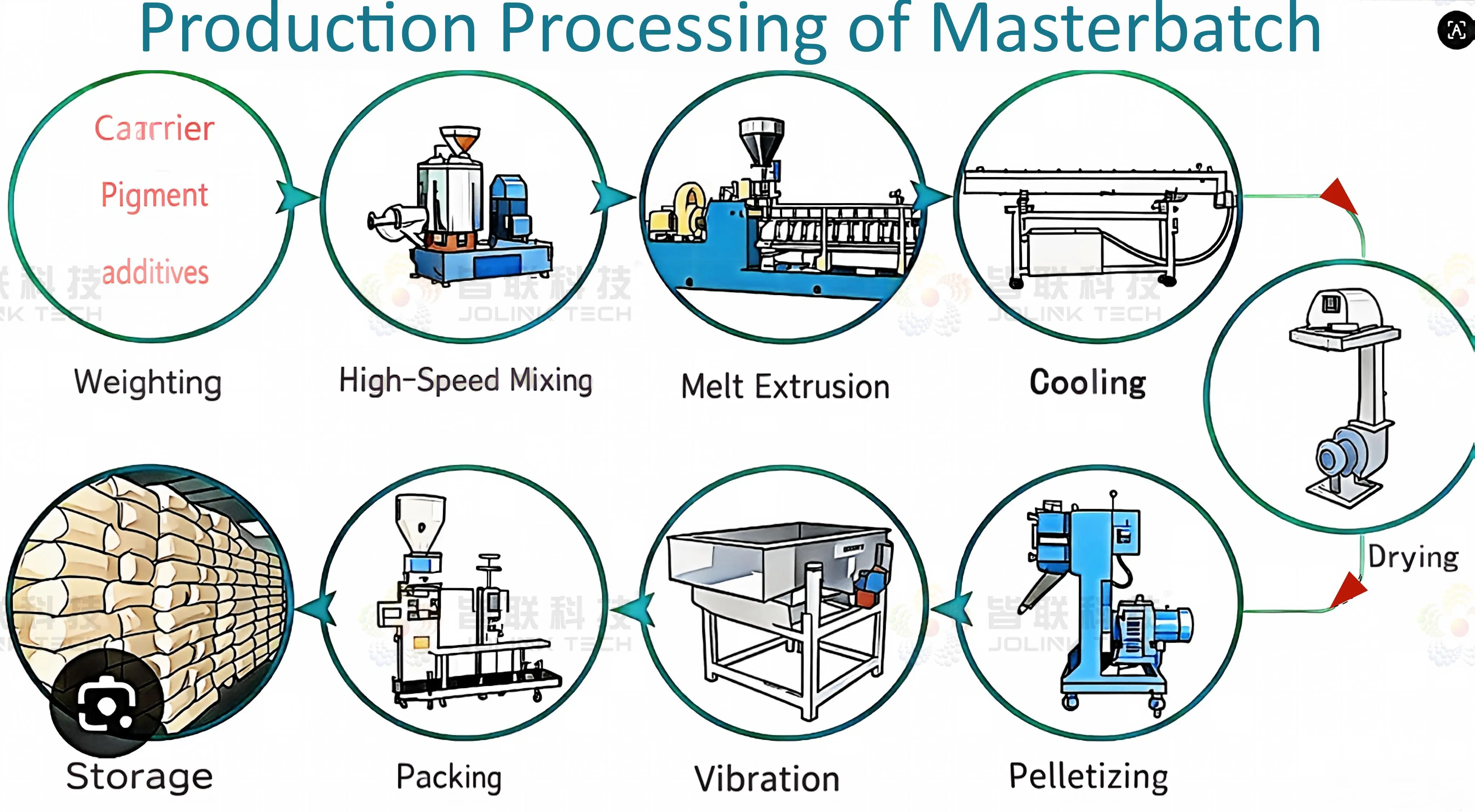
Next time, when you hold a single masterbatch in your hand that has been stored in the warehouse, perhaps you would also like to know how many rotations it has undergone in the twin-screw machine?
We are always ready to offer technical support or provide samples. Please feel free to leave a message or contact us.https://www.jolink-masterbatches.com/contact-us
Have you ever thought about it?
The black granules that come out of your injection molding machines, blown film machines and pipe extrusion barrel, before being poured into your hopper, have gone through how many production processes?
Today, let's take a look at:
Step 1: Raw material weighting
Weigh according to the formula, just like the doctor in traditional Chinese medicine clinic mixing a specific type of medicinal herb.
Carbon black: 20% - 50% (depending on formula);
Carrier resin (PE, PP, ABS, EVA, etc.);
Dispersants, additives, etc. (according to formula).
The color and performance of the raw materials have already been qualitatively here.
Step 2: High-speed Mixing
The raw materials enter the high-speed mixer for pre-mixing, allowing the carbon black to evenly adhere to the surface of the resin, preparing for the next process; this step needs carried out evenly, eliminating the risk to make corrections later.
Step 3: Melt Extrusion
The mixture materials enter the twin-screw extruder, where it melts at the certain temperature. The shear force of the screws disperses the carbon black aggregates into the resin (this is the core process). Using the same batch of raw materials, why are some black masterbatch bright and uniform, while others are full of black spots? The answer is: Poor dispersion.
The quality of the black masterbatch is basically determined in the twin-screw.
Step 4: Pelletizing
This is the process where the masterbatch is transformed from molten state into granules. The extruded strips or droplets are cooled with water and then cut into granules. The uniformity of the granule size will affect the stability of downstream transportation and measurement.
Step 5: Drying and Screening
The particles are dried, dehydrated, screened to remove impurities, powdered and non-standard particles are removed through screening.
If there is too much powder of the masterbatch, it is likely to cause blockage during use by the customer, resulting in unstable material feeding. Do you think customer complaints often arise from this?
Step 6: Quality Inspection (QC)
Chromatic aberrationΔE, dispersion, melt index (MFR/MI), filtration pressure value FPV (the lower the value, the better the dispersion), moisture content. If any one of these indicators fails to meet the standards, the product must not be released from the factory!
Step 7: Packaging
25kg paper-plastic composite bags (for moisture and dirt prevention), automatically weighed, sealed, stacked and stored in the warehouse.
Masterbatch, transforming from a pile of powder into individual particles, requires seven processes to complete.
It may seem simple, but to achieve sufficient darkness and stable performance, with consistent stability from batch to batch, this is the true threshold for a qualified masterbatch.
Next time, when you hold a single masterbatch in your hand that has been stored in the warehouse, perhaps you would also like to know how many rotations it has undergone in the twin-screw machine?
We are always ready to offer technical support or provide samples. Please feel free to leave a message or contact us.https://www.jolink-masterbatches.com/contact-us

Contact Us
Tel: +86 757 8118 6668/+86 139 2320 6383
Sales Hotline: +86 139 2320 6383
Address: No. 55, Yong'an Avenue, Guanyao, Shishan Town, Nanhai District, Foshan City, Guangdong Province, China.
Inquire
Copyright © 2026 Guangdong Jolink Technology Co., Ltd.